
About me
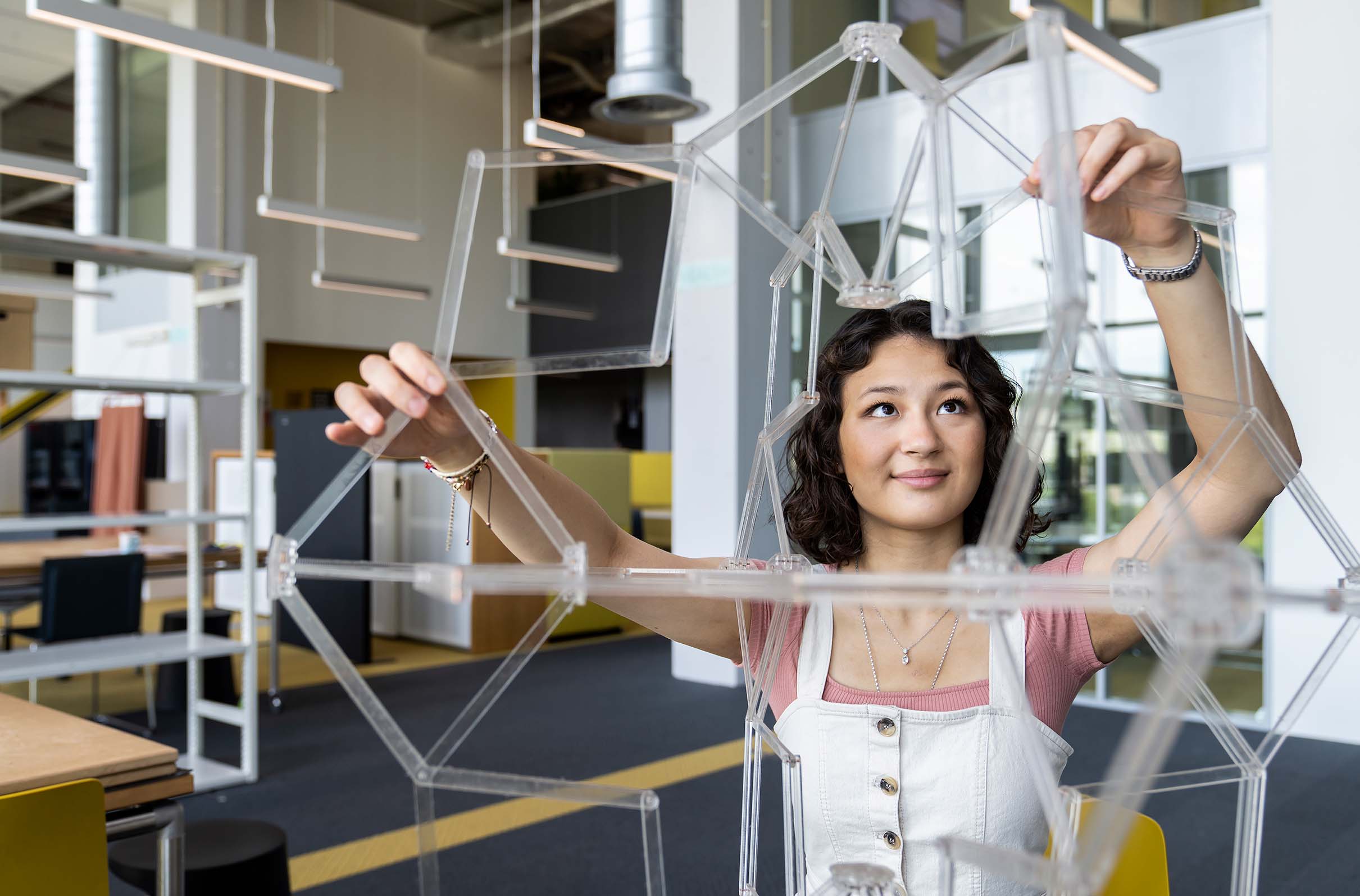
Name
Elke van Dael
Education
Major
Industrial Design
Languages
Dutch, English
Strategic thinking
Stakeholder management
Creative facilitation
Hands-on approach
Project management
My vision
Imagining futures sparks my curiosity, and I aspire to evoke other people’s imagination as well. We can only strive for a better future for all if we are able to dream one in the first place. I believe that when imagination unites with creative approaches, there will be plenty of opportunities for envisioning and creating alternative futures to the status quo.
Following the news makes it clear to me that there is a pressing need for transformation. The world is facing seemingly unsolvable and increasing issues. Examples are climate change and inequality. In order to decrease the risk of societal collapse, we have to be able to imagine radically different approaches. Imagination is essential in paving the way for social innovation [1].
The challenge is that we are currently in an “imaginary crisis” [2]. Despite the huge potential social imagination offers for moving towards sustainable societal futures, there is surprisingly little engagement in effective future thinking. It is apparent in all layers of society. I see it in politics for instance, where the lack of a convincing progressive story invigorates conservatism.
In light of the imaginary crisis, UNESCO has the mission to stimulate Futures Literacy [3]. Futures Literacy is the skill of imagining futures. UNESCO argues it is vital to society that the skill is made accessible to everyone, and I believe design can contribute to that. In my own experience as a designer, practicing my imagination has brought many benefits; among which a problem-solving mindset, but most importantly hope, excitement and motivation for creating the future instead of merely being a passive spectator of what is to come in my own life. I wish this source of positivity for anyone.
Social imagination is inherently a practice done together [4]. I am convinced that future thinking should include and represent multiple perspectives. It is important to look beyond individual perceptions to see the bigger picture, enabling us to deal with unprecedented problems together [5]. Only by involving each other, we can prevent as much as possible that the solutions of today create the problems of tomorrow [6]. In a nutshell, I strongly believe that the key for managing societal change is combining different views.
In my opinion, especially designers are designated to support Futures Literacy and pioneer the many ways towards desirable sustainable futures. As a social designer I view myself as a facilitator for imagination, laying out infrastructure in the form of future thinking tools and methods [7]. I have explored this in my projects Democratised Future Visioning, Creative Futuring for Organisations, and Future Thinking On the Job. My ambition is to encourage and enable everybody to imagine value-based futures. Only then we can progress collectively into a future valuable to all.
[1] MSISweden. (2021, November 9). Social Innovation Foresight #1 on Social Imagination [Video]. YouTube. https://www.youtube.com/watch?v=JUjIZIocB2Q
[2] Mulgan, G. (2020). The Imaginary Crisis (and how we might quicken social and public imagination). UCL and Demos Helsinki.
[3] UNESCO. (n.d.). Futures Literacy & Foresight. https://www.unesco.org/en/futures-literacy
[4] Candy, S., & Dunagan, J. (2016). The experiential turn. Human Futures, 1(1), 26-29.
[5] Rovers, E. (2022). Nu is het aan ons: oproep tot echte democratie (1st ed.). de Correspondent.
[6] Mommers, J. (2020). Hoe gaan we dit uitleggen: onze toekomst op een steeds warmere aarde. De Correspondent.
[7] Robinson, C. (2023, January 7). Imagination Infrastructures at Anticipation Conference. Medium. https://cassierobinson.medium.com/imagination-infrastructures-at-anticipation-conference-ad0e1837d48b
Description of my professional identity
The profile that positions me best is a social designer who loves visionary and strategic thinking. I like to spark overall engagement with creative approaches, tangible tools and hands-on methods, just like I have explored in my projects. For future thinking specifically, I would like to apply my skills to create structures of participation for co-imagining [1].
In my projects I always aim to involve stakeholders and look for the input of experts. I am eclectic: I see value in involving as many perspectives as possible so exciting ideas can be co-created collaboratively. Besides, experts can fill in my lack of knowledge and experience in areas like data computation or when highly technical expertise is required.
My strength is bringing people together. I consider myself as an openminded and empathic person. A side effect is that I can be reluctant to make decisions when I have not yet seen all perspectives. When I encounter the challenge of stakeholders having misaligned attitudes, I try to solve this complexity by listening and finding common ground.
In the design process I am typically structured and thorough. I prefer iterative project processes like scrum because it leaves room for unexpected findings and twists. I learned to work with this method during my board year at Study Association Industrial Design Lucid. When I work in a team I tend to keep overview and communicate clear steps. Since I personally regard ideation as the most challenging part of a design process, fellow team members can be especially complementary when they are inspirational and full of ideas so I can build on them.
The term “intrapreneurship” could be interpreted as what I envision myself doing in employment; I would like to encourage organisations to take on more creative approaches and an entrepreneurial, future-oriented mindset regarding societal responsibility. To this end, I could deploy my skills to facilitate workshops or service trajectories. When I would not be operating from within an organisation, I could take the role of an organisational consultant.
In order to realise my vision, which strives for more future thinking, I will keep developing myself as an explorative yet thoughtful designer. I believe one of the qualities of designers is that we can act quickly to elicit societal change. Simultaneously, I intend to remain critical and conscious about societal impacts through continuous reflection. I am always eager to learn new methods and to empower myself to design creative future thinking approaches.
[1] Candy, S. (2018, January). Dreaming Together: Experiential Futures as a Platform for Public Imagination. In T. Durfee & M. Zeiger (Eds.), Made Up: Design’s Fictions (pp. 44–48). ArtCenter.
Social Design